
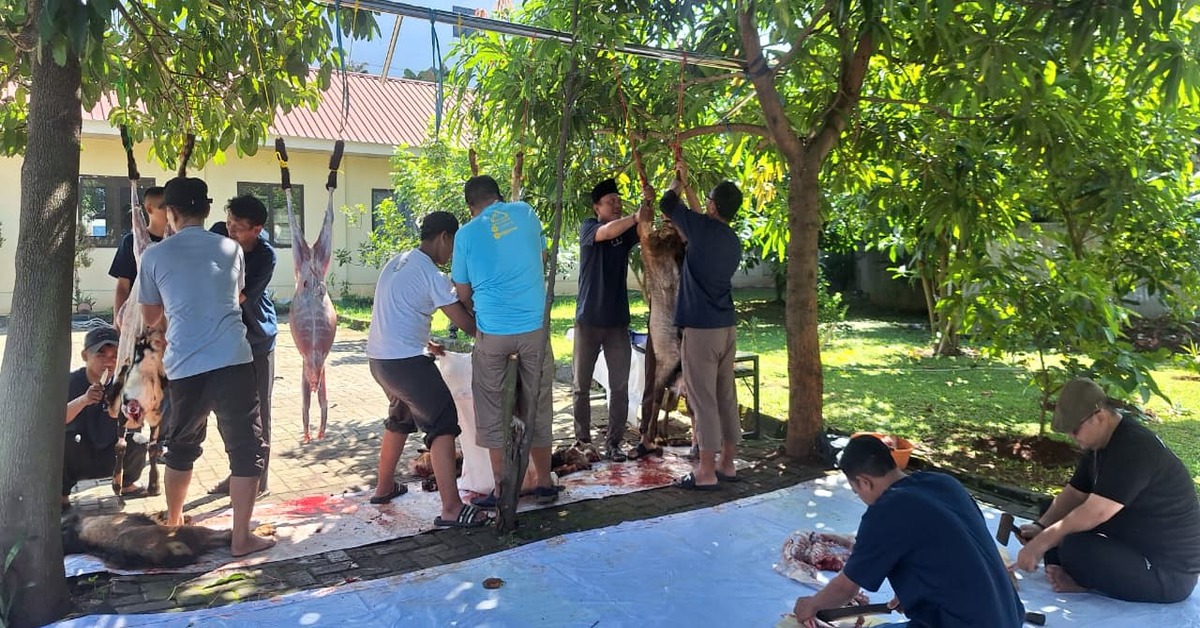
Qurban and Sustainability: Slaughtering Cattle, Not Harming the Earth
Eid al-Adha is here again. It’s a time synonymous with the aroma of satay wafting through every alleyway, plumes of smoke that sting the eyes, and of course: family WhatsApp groups suddenly flooded with photos of sacrificial committee members looking resigned as they’re kicked by a 500-kilogram cow, or videos of residents suddenly turning into a fun run as they chase an escaped sacrificial cow.
Sacrifice is a noble act of worship, a symbol of piety, and a form of social compassion. However, for reasons unknown, this sacred ritual is often accompanied by secondary rituals that are somewhat less environmentally friendly: a festival of black or red plastic and the creation of impromptu “rivers of blood” in residents’ gutters.
Gutters Are Not Dracula
Let’s be honest. Every time Eid al-Adha ends, the gutters around slaughterhouses often turn a deep red, accompanied by a dystopian stench that lingers for up to a week. Logically, we are making sacrifices to draw closer to the Creator, but why are our neighbors’ gutters being sacrificed as waste dumps?
In fact, in the Qur’an, Allah SWT has already issued a stern “rebuke” regarding human behavior that habitually destroys the environment. In Surah Ar-Rum, verse 41, Allah states:
“Corruption has appeared on land and sea because of what people’s hands have wrought; so that Allah may let them taste some of the consequences of their deeds, so that they may return (to the right path).” (QS. Ar-Rum: 41)
Dumping sacrificial blood directly into the gutter is a tangible form of “corruption on land” that automatically gives neighbors a headache. Animal blood is biological waste. If it flows into the gutter, it will rot, attract flies, and create a bacterial ecosystem ready to attack residents’ digestive systems for the entire season. The solution is actually simple: dig a special hole in the ground (an emergency septic tank), and bury the animal blood and waste there. Let the soil process it into fertilizer. The earth is happy, the worms are happy, and neighbors won’t have to wear double masks inside their homes.
The Shift from Black Plastic Bags to Bamboo Baskets
The second common ecological sin is our obsession with plastic shopping bags, especially the jet-black ones made from recycled waste—who knows what kind.
Just imagine: a single cow can yield hundreds of meat bags. If there are ten cows at a single mosque, thousands of plastic bags are distributed to the community. Tragically, these plastic bags often end up in the trash just an hour after the meat hits the pan. We want to earn rewards, but what flows instead is plastic waste into the ocean.
The Prophet Muhammad (peace be upon him) forbade us from causing harm—whether to ourselves or to the environment. In a hadith narrated by Ibn Majah, the Messenger of Allah (peace be upon him) said:
“There must be no harm, and one must not cause harm to others.” (HR. Ibn Majah)
Plastic, which takes hundreds of years to decompose, is clearly a real “dharar” (harm) to the future of our grandchildren. So, what is the solution? Should we carry the sacrificial meat with our bare hands just to show off how stylish we are? Of course not.
Let’s return to a local wisdom that’s far more sophisticated: bamboo baskets lined with teak leaves.
Distributing sacrificial meat in bamboo baskets lined with teak or banana leaves isn’t just eco-friendly—it also enhances the aesthetic appeal. Your sacrificial meat instantly looks like a premium traditional delicacy, not like confiscated goods wrapped in black plastic bags. Moreover, teak leaves contain natural substances that are safe and do not melt when exposed to the heat of the still-warm meat, unlike recycled plastic, which can transfer harmful chemicals to the meat.
A Meaningful Sacrifice, A Safe Earth
The ritual of sacrifice is about sincerity and compassion. It is deeply contradictory to seek Allah’s pleasure through a piece of meat while simultaneously leaving a tangible trail of environmental damage on the earth He created.
Preserving nature isn’t just the job of activists who love wearing green shirts and protesting factories. The duty to protect the environment rests with every individual who claims to have faith.
Let’s change the trend for this year’s Eid al-Adha. Sacrifice committees shouldn’t just be busy sharpening knives, but also digging holes in the ground and ordering bamboo baskets from local artisans. Let’s prove that Muslims can perform their worship with devotion while also being at the forefront of preserving nature.
After all, what’s the point of feasting on satay today if tomorrow we’ll be flooded because the drains are clogged and the earth is dying? Happy Eid al-Adha. Let’s perform our sacrifices wisely, cleanly, and greenly!
Ady Cahyadi
Lecture at FEB UIN Jakarta